Thursday, September 17, 2015

Project Signal Generator

I've thought about making a function generator for quite a while now - I've even tried, and failed, to make one in the past.  Currently my motivation to make one is due to wanting to find out what the actual resonance frequencies are for my different Tesla Secondary Coil and Top Load combinations and so I can design and make a Dual Resonant SSTC.  I can calculate predicted resonant frequencies using tools like Deep Fried Neon TC Calculators but this does not provide actual values (parts all have tolerances - actual values can differ by a certain percent).  Being able to match frequencies using actual measured resonance frequencies becomes important with DRSSTC's (regular SSTC's only have a single resonance circuit and the primary tank circuit can self tune with feedback).   To be able to find these resonance frequencies I'll need an actual function generator to generate signals to determine actual values.

What is a Signal Generator (Wikipedia link) - basically a signal generator is a device that can produce waveform's (like sine-wave, square-wave, triangular-wave, saw-tooth-wave's) at various frequencies. Commercial signal generators are fairly expensive- unless you are lucky enough to run across older ones for sale (I have not been that lucky yet - I keep looking though).

http://pemfsite.com/tag/triangular-wave/
Since a commercial model is out my price range I've been researching methods to make one, that can actually produce the frequencies that I need for my Tesla coils - about 200kHz).   Square waves are fairly easy to produce with either 555 timer chips or micro-controllers, the others are a bit tougher to produce.

I have found a number of methods that may work using specific IC's designed as Signal Generators, Op Amps configured to produce different signals, function libraries for Arduino micro-controllers (audio signal generation), and DDS (Direct Digital Synthesizer).

I am currently working on all of these approaches and I will update my results with each after I get each one functional.


Resources (datasheets, etc.):
LM348-Signal Generator
XR2206 Monolithic Function Generator IC
MAX038 Waveform Generator
ICL8038 Precision Waveform Generator
AD9850 (DDS IC)
(the first 3 are discontinued products but are still available on ebay)

UPDATES on the above Signal Generators
ICL8038
AD9850 part1

Wednesday, August 26, 2015

Chicago Southland Maker Faire 2015

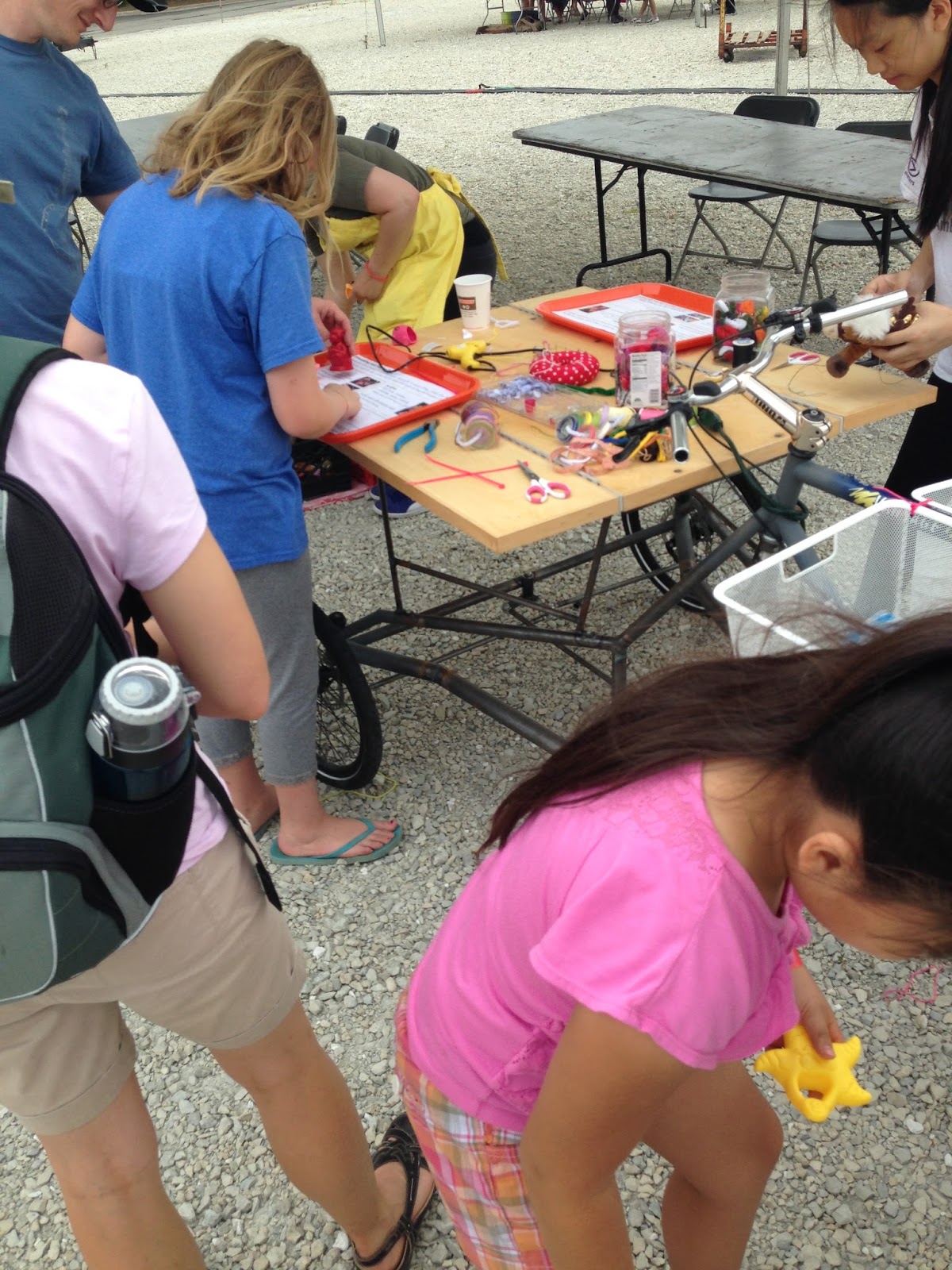
The Chicago Southland Maker Faire was held just this past weekend.  The weather was perfect and there was a great turnout for the event (both in terms of exhibitors and attendees).


My Tesla Coil Exhibit

Cool Star Wars cosplay


Worshop88 Pen Plotter


Virtual Sandbox

Electric Racers

Overview shot from back

SouthWorks Maker Lab Network

 To see more info on  classes, etc. check out SouthWorks Maker Lab Network
Telescopes from Spacelab


Chicago Southside Maker Faire 2015

In an attempt to catch up from the past month or so, I'm posting a good number of posts over a short period of time,  For the first - Chicago Southside Maker Faire was held just a few weekends ago (Aug. 8th) at Ford City Mall.  Just like last year, I got lost on my way there (due to me and Goggle Maps).  My daughter and I did arrive before noon but only had about an hour to check out everything (not enough time) since I had to get her to a party for her school

Anyway, here are some photo's of the event:


Saturday, August 8, 2015

Project SSTC1 - I've got Sound!!!

After reviewing datasheets, yet again, for the MOSFET drivers I'm using (TI's UCC37321/2) and re-reading some sources on interrupters for SSTCs and methods of audio modulation with SSTC's I finally had that Ah-Ha moment.

I've made Plasma Speakers / Singing Arc's just after building my first Spark Gap Tesla Coils.  These, generally took an audio signal (normally fed to a speaker or earphones) and put it through the driver for a Television Flyback Transformer.  The only method I used involved amplitude modulation (AM-like radio) and SSTC audio drivers seem more focused on frequency and pulse width modulation.  Correction, after re-reading datasheets for the LM555 timer chip I learned that pin 5 actually modulates the frequency (some descriptions I had read stated, incorrectly, that pin 5 adjusted the output amplitude.  I finally understood how you combine frequency and pulse width modulation (it's actually pretty simple and involves pretty simple calculations).

I'll get more into the difference later, for now here's the video:


Saturday, August 1, 2015

Project SSTC1 - SUCCESS AT LAST !!!

Finally, my SSTC (Solid State Tesla Coil) is working.  My Driver Board and Interrupter Board have been working fine all along it has just been my high power side - the half H-Bridge board.  I have burned out many MOSFET's trying to get the Half H-Bridge Board to work, my last test (less than a week ago) burned out 2 MOSFET's - I think it may have been due to overheating.

After re-designing my H-Bridge Board again and adding heat sinks (cut from an old CPU chip heat sink) and a cooling fan - it all finally works - no overheating, no magic smoke being released just nice plasma from the coil.

Thursday, July 30, 2015

Project SSTC1 - Reviving my Tesla Coils and taking them further Southland Mini Maker Faire

I first saw instructions on building a Tesla Coil back in the early 1980's, in either Popular Science or Popular Electronics magazine, while at science camp over summer break during elementary school.  The design used a multiple gap spark gap (copper tubes inside a cylinder - which I now know is a Richard Quick Spark Gap) and capacitors made out of window panes and aluminum foil.  It looked Super Cool to me but the concepts were beyond my understanding and the idea of building it was a bit scary (I couldn't imagine who I could ask for help or even just address my questions),

The picture stuck in my mind - I just wanted to see one up close and in person. While on a road trip up the East Coast (early 90's) I saw a sign (it was somewhere either near or in Boston, MA) where they had some big coils that they used for a lightning display.  I remember going by the museum to find that the exhibit was closed.  Tesla Coils and man made lightning retreated in my mind.

Fast forward about 20 years - While working with my daughter on some basic electronics projects - make a simple electric motor using a magnet, magnet wire, a battery, paper clips and soda straws I thought why not make sparks!!!

I was really thinking about static electricity (I loved being able to shuffle across the carpet so I could reach out my finger to ZAP my brother or sister - they did the same to me of course).  So, I thought why not make a Van De Graff Generator.

After building a small one, that did work, just not very well I wanted a more impressive display.   A Tesla Coil seemed to be the answer, so I began my research (thinking it would only take a few weeks to build it). Well, it took a bit longer - more like 4 months research, trial and error, failures and finally success.


During my process of building the coil I was showing videos of Tesla Coils (on YouTube.com) to my daughter and we came across Tesla Coils that could play music.   That just seemed so amazing, I looked into how people were able to do it.  It appeared fairly complicated but I found something I might be able to do - an audio modulated Plasma Arc (or Plasma Speaker).  I did try building a basic Solid State Tesla Coil (Steve Wards Mini SSTC), but I just kept blowing MOSFET's and they were expensive and I had to get them by mail order.  So, I put the project on hold until I had more knowledge.

Now, I'm finally going for it and I thought exhibiting at the Southland Mini Maker Faire would be great motivation to finish it .  I re-built my half H-Bridge driver board (using my CNC to mill the board).  I connected everything up and it WORKED.


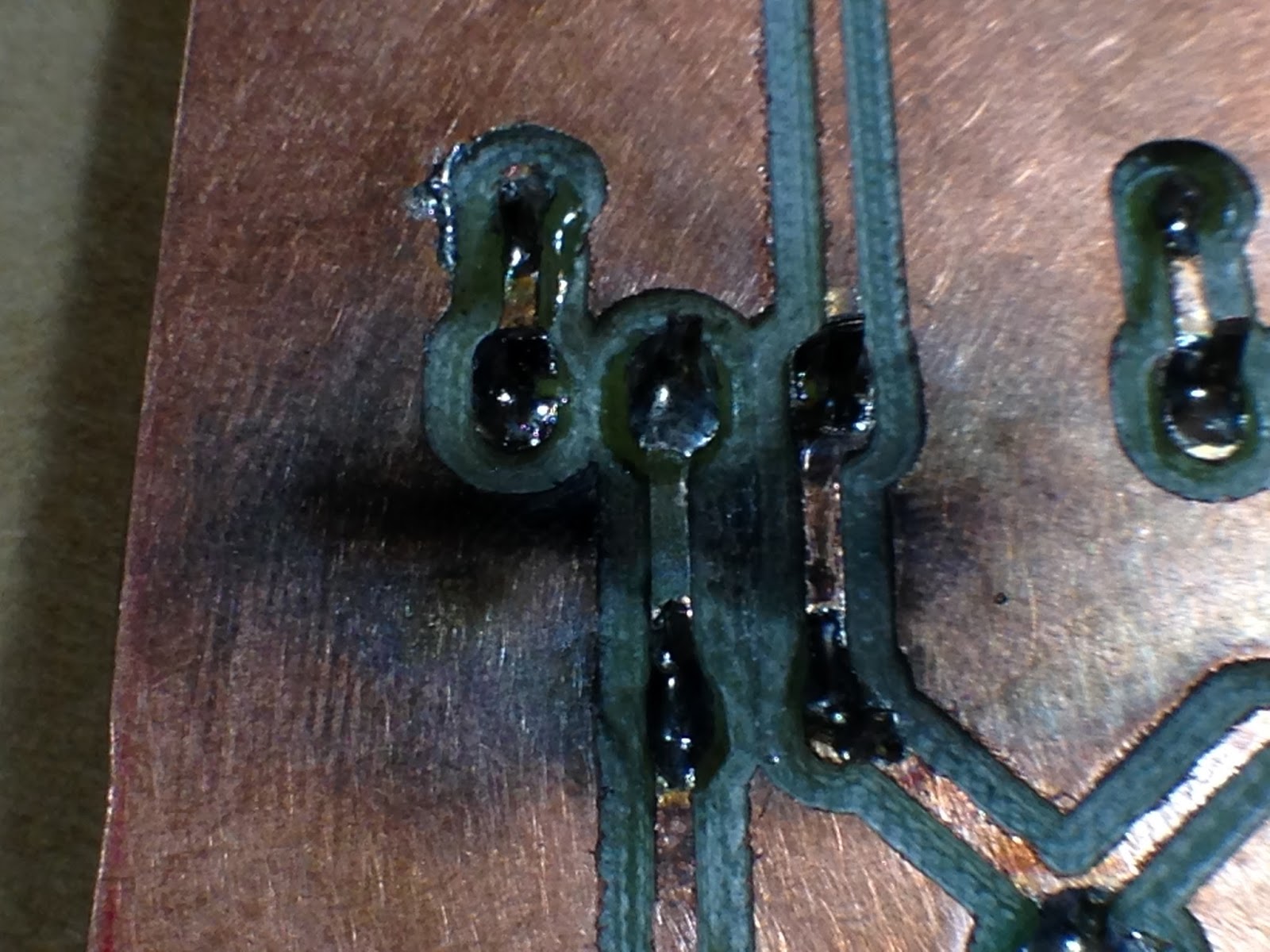
Well, for a few minutes at least and then a POP and some smoke.  The MOSFET's were quite hot and looking at my new board I saw...


Missing trace
A trace shorted and vaporized.  After desoldering all the components I determined that both MOSFET's were dead but all other components were fine.

I re-made the board on perfboard and added big heat sinks to the MOSFET's and a fan to help keep then cool.  No full test yet, ramping power up slower to make sure everything is OK.
New Half H-Bridge Board


Cut copper pads from around component connections to minimize arcing.

Monday, July 27, 2015

Chicago Southland Mini Maker Faire

I finally submitted my registration for the Chicago Southland Mini Maker Faire.
This year I'm building an audio Tesla Coil (or: audio modulated, singing Tesla Coil etc).  I've built a good number of Spark Gap Tesla Coils but my attempts at building a Solid State Tesla Coil seem to result in dead MOSFET's and magic blue smoke.